Loading...

Most American undergraduates are surprised to learn that a 2000-word essay can range from just four to eight pages depending on formatting. Getting your academic paper to precisely fit the required word count and page length is tougher than it looks, especially when every detail from font choice to line spacing can shift your results. This guide breaks down why understanding formatting rules matters and shows how you can confidently meet university standards without falling short or going over.
| Point | Details |
|---|---|
| Understanding Word Count | Accurate word count is crucial for meeting academic requirements and evaluating complexity in written work. |
| Impact of Formatting | Formatting choices like font type, spacing, and margins affect the total page count of documents significantly. |
| Compliance with Standards | Students must adhere to specific institutional formatting guidelines to ensure consistent and professional document presentation. |
| Common Writing Mistakes | Avoid grammatical errors and ensure clear argumentation to improve the overall quality and credibility of academic papers. |
Understanding word count and page length is fundamental to academic writing success. Accurate word count measurements serve as the foundation for meeting academic assignment requirements, providing a clear quantitative framework for written work. Word count represents the total number of words in a document, functioning as a precise metric that universities and instructors use to evaluate document length and complexity.
Page length introduces additional complexity beyond raw word count. Formatting factors like font size, line spacing, margin width, and typography significantly impact how many physical pages a specific word count will occupy. Standard academic formatting typically assumes 12-point Times New Roman font, double spacing, and one-inch margins. Under these standard conditions, most students can expect approximately 250-300 words per page, though this can vary based on specific document requirements.
Most academic assignments specify exact word count ranges rather than page numbers to ensure consistency across different formatting approaches. Research writing standards recommend that students first focus on meeting the word count requirement precisely, then adjust formatting to match institutional guidelines. This approach ensures that the substantive content receives primary attention, with formatting serving as a secondary consideration.
Quick Tip: Always confirm the specific formatting requirements with your instructor before starting your assignment to avoid unnecessary revisions.
Understanding the variables that influence page length is critical for academic writing precision. Academic formatting guidelines reveal several key factors that dramatically impact how many pages a document will occupy. Font selection, line spacing, margin dimensions, and paragraph structure are the primary elements determining the physical length of a written work.
Font characteristics play a significant role in page count calculations. Standard academic fonts like Times New Roman and Arial have different character densities, which means the same word count can produce varying page lengths. A 12-point Times New Roman font typically allows 250-300 words per page, while a more compact font like Calibri might accommodate 275-325 words in the same space. Line spacing further complicates this calculation - double spacing increases page count compared to single spacing, effectively expanding the document's physical length.

Research writing standards emphasize that margin dimensions and paragraph formatting also substantially influence page numbers. Standard academic guidelines typically recommend one-inch margins on all sides, but slight variations can compress or expand total page count. Paragraph indentation, heading spacing, and the inclusion of block quotes or special formatting elements can cause additional page length fluctuations. Students should always confirm specific institutional requirements to ensure their document meets exact formatting expectations.
Quick Tip: Create a template document with your institution's exact formatting requirements to automatically control page length and formatting consistency.
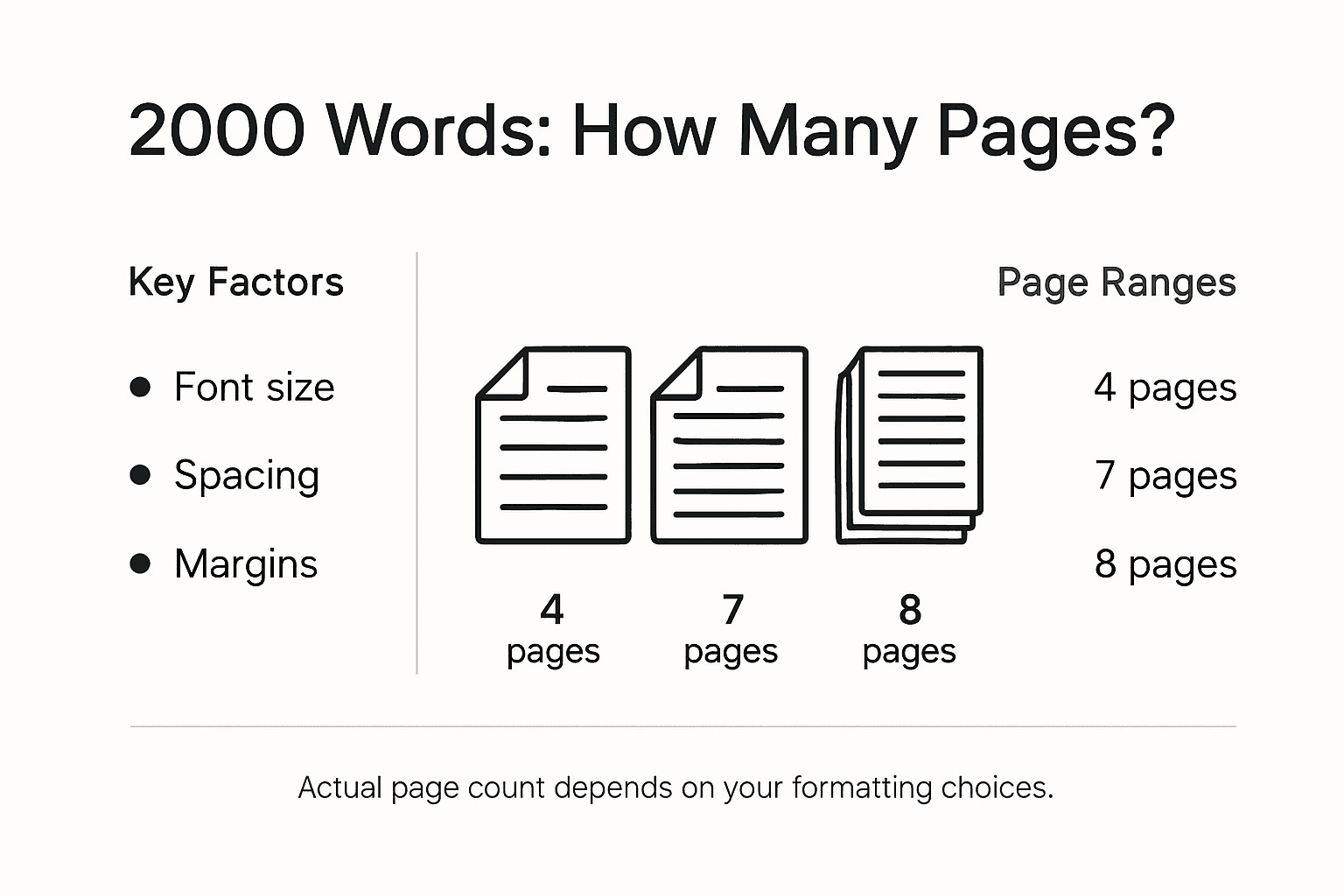
Academic writing standards reveal that a 2000-word document typically spans between 4 to 8 pages, depending on specific formatting parameters. This variability underscores the importance of understanding how document settings can significantly impact overall page length. Students and researchers must recognize that word count alone does not directly translate to a fixed number of pages.
The most common academic formatting approach involves double spacing with a 12-point Times New Roman font and standard one-inch margins. Under these conditions, standard writing guidelines suggest that 2000 words will typically occupy approximately 7 to 8 pages. However, subtle changes in formatting can dramatically alter this page count. Single spacing, for instance, can reduce the document to roughly 4 pages, while using a slightly more compact font might compress the text even further.
Several key variables influence the final page count beyond basic formatting. Paragraph structure, inclusion of block quotes, headings, and even the complexity of the language used can affect how many pages a 2000-word document will require. Academic disciplines often have specific formatting requirements, so students should always consult their institutional guidelines to ensure precise compliance with expected page length and formatting standards.
Here's a quick reference for how formatting choices affect the page count of a 2000-word academic paper:
| Formatting Type | Font & Size | Line Spacing | Approx. Pages |
|---|---|---|---|
| Standard Academic Format | Times New Roman, 12pt | Double | 7-8 |
| Compact Font Option | Calibri, 12pt | Double | 6-7 |
| Single Spacing Format | Times New Roman, 12pt | Single | 4 |
| Increased Margins | Times New Roman, 12pt | Double | 8-9 |
| Wide Line Spacing (1.5 lines) | Arial, 12pt | 1.5 | 5-6 |
Quick Tip: Create a digital template with your institution's exact formatting requirements to automatically control and predict your document's page length.
Academic writing guidelines establish critical formatting standards that are fundamental to professional academic writing. These guidelines provide a comprehensive framework for document preparation, ensuring consistency and readability across different academic disciplines. Standard formatting involves precise specifications for font selection, margin dimensions, and spacing that directly impact the document's overall presentation and professional appearance.
The most widely accepted academic formatting standard recommends using Times New Roman at 12-point size, with one-inch margins on all sides and double line spacing. Professional writing style guides emphasize the importance of these specific parameters, which help maintain uniformity and ensure optimal readability. Different academic disciplines may have slight variations in their formatting requirements, but these core principles remain relatively consistent across most scholarly writing platforms.
Beyond basic font and margin specifications, academic formatting includes additional nuanced requirements. Paragraph indentation, typically set at 0.5 inches, helps distinguish new paragraphs and improve document structure. Header formatting, page numbering, and citation style also play crucial roles in meeting institutional writing standards. Students and researchers must pay careful attention to these details, as proper formatting can significantly impact the perceived quality and professionalism of academic work.
Below is a summary of typical academic formatting standards and their importance:
| Formatting Element | Standard Specification | Purpose/Impact |
|---|---|---|
| Font | Times New Roman, 12pt | Enhances readability |
| Margins | 1 inch on all sides | Ensures uniform layout |
| Line Spacing | Double | Improves clarity for review |
| Indentation | 0.5 inch at paragraph start | Aids document organization |
Quick Tip: Create a digital template with your institution's exact formatting requirements to ensure consistent and professional document preparation.
Academic writing research reveals numerous critical errors that can undermine the quality and credibility of student papers. Writing mistakes range from technical grammatical issues to more complex problems of argument structure and academic integrity. Understanding and proactively addressing these common pitfalls can significantly improve a student's academic writing performance and overall scholarly communication.
Grammatical and structural errors represent the most fundamental challenges students encounter. Common issues include subject-verb agreement problems, improper comma usage, sentence fragments, and run-on sentences that disrupt the clarity and flow of academic writing. Scholarly writing standards emphasize that these technical errors not only diminish the professional appearance of a document but can also compromise the reader's ability to understand the intended message. Students must develop a keen eye for grammatical precision and learn to edit their work meticulously.
Beyond technical writing skills, academic papers often suffer from more substantive problems. Weak thesis statements, inadequate argument development, and insufficient understanding of assignment guidelines can significantly undermine the overall quality of scholarly work. Plagiarism represents another critical concern, with many students inadvertently compromising their academic integrity through improper citation or unintentional knowledge borrowing. Developing strong research and writing skills requires a comprehensive approach that addresses both technical writing proficiency and deeper academic communication principles.
Quick Tip: Always have a trusted peer or writing center consultant review your paper before final submission to catch subtle errors and improve overall document quality.
Navigating how many pages your 2000-word essay will fill can be confusing due to varying formatting rules and academic standards. You might be struggling to balance word count accuracy, proper formatting, and clear structure while avoiding common pitfalls like inconsistent spacing or poor paragraph organization. Whether you need help meeting exact page length targets or ensuring your essay aligns with specific academic guidelines, Samwell.ai is here to help you write smarter and faster.

Unlock the power of AI-driven academic writing with Samwell.ai. Our platform offers advanced tools such as the 'Power Editor' to refine and expand your content, plus 'Guided Essays' that provide structured outlines tailored to your assignment requirements. Forget about formatting worries or plagiarism concerns; Samwell.ai’s unique Semihuman.ai technology ensures originality and compliance with MLA, APA, and other styles. Start shaping your 2000-word paper into the perfect number of pages today and meet your academic goals with confidence. Explore how you can streamline your essay writing process at Samwell.ai and redefine your scholarly success.
A 2000-word essay typically spans 7 to 8 pages when formatted in 12-point Times New Roman font, double-spaced with standard one-inch margins.
Yes, formatting choices such as font type, line spacing, and margin size can significantly impact the page count. For example, single spacing can reduce a 2000-word document to approximately 4 pages.
Most academic writing follows standard formatting guidelines that include using Times New Roman at 12-point size, one-inch margins on all sides, and double line spacing for consistency and readability.
To ensure your essay meets the required word count, use a word processor with a word count feature, adjust your formatting according to the guidelines, and focus on the substance of your content first before making formatting changes.