Loading...

Even the most confident American students face confusion when starting a new research paper. Academic writing requires more than bright ideas—without careful organization, even valuable insights can get lost. In fact, over half of academic papers lose clarity due to poor planning and source management. This guide walks you through proven steps for structuring research, integrating credible sources, and mastering the details that set exceptional work apart.
| Key Point | Explanation |
|---|---|
| 1. Identify core research question | Start your research by defining a central question that guides your investigation and subsequent decisions. |
| 2. Develop a robust tracking system | Use digital tools to catalog sources and organize references, simplifying retrieval during writing. |
| 3. Create a detailed outline | Structure your outline according to discipline standards, ensuring clear organization and flow of arguments. |
| 4. Integrate credible sources effectively | Use high-quality academic sources to support your arguments and maintain a balance between your analysis and evidence. |
| 5. Thoroughly proofread your work | Conduct multiple reviews focusing on structure, grammar, and citations to ensure a polished final document. |
Research organization is the backbone of successful academic writing. In this critical initial stage, you'll create a systematic approach that transforms scattered ideas into a coherent research strategy.
Start by identifying your core research question or thesis statement. This acts as your academic compass, guiding every subsequent research decision. Break down this overarching question into specific, manageable sub-questions that will help you explore different dimensions of your topic. For instance, if your main research question examines climate change impacts, your sub-questions might explore environmental, economic, and social dimensions.
Next, develop a comprehensive research tracking system. Use digital tools like reference management software to catalog your sources, take detailed notes, and organize your references. Create separate folders for different source types journal articles, books, online resources, and primary documents. Add tags and keywords to make future retrieval easier.
As you collect sources, critically evaluate each one. Ask yourself: Does this source directly support my research objectives? Is it credible and peer-reviewed? How recent is the information? Prioritize academic journals, scholarly books, and reputable research publications over general web sources.
Draft a preliminary research outline that maps your potential arguments and evidence. This living document will evolve as you dive deeper into your research, but it provides crucial structure and direction. Include placeholders for key sections like introduction, methodology, findings, and conclusion.
Pro tip: Create a research tracking spreadsheet with columns for source details, key quotes, page numbers, and how each source connects to your specific research questions. This saves enormous time during the writing process and prevents last minute citation hunting.
Here's a summary of tools and strategies that streamline academic research organization:
| Tool/Strategy | Primary Purpose | Benefit to Research Workflow |
|---|---|---|
| Reference management software | Catalog sources and citations | Ensures reliable record keeping |
| Folder categorization | Organize by source type | Simplifies retrieval and review |
| Tagging/keywords | Quick searching of materials | Saves time during writing |
| Research spreadsheet | Track quotes and page numbers | Reduces errors and omissions |
Creating a well structured academic outline is crucial for presenting your research systematically and professionally. In this step, you'll learn how to craft an outline that meets rigorous academic standards and provides a clear roadmap for your paper.

Start by understanding the standard components of an academic outline. Most disciplines require a consistent structure that includes specific sections. Academic writing guidelines recommend including key elements such as title page, abstract, table of contents, introduction, main body sections, conclusion, and references. Each section serves a specific purpose and contributes to the overall coherence of your document.
Begin by mapping out your main sections based on your research question. Typically, academic papers follow a logical progression: introduction that frames your research, methodology explaining your approach, results or findings, discussion of those results, and a conclusion that synthesizes your key insights. Within each main section, create subsections that break down complex ideas into digestible components. Ensure each subsection connects smoothly to the next, creating a narrative flow that guides readers through your argument.
Pay close attention to discipline specific formatting requirements. Science papers might emphasize methodological details, while humanities papers might require more interpretive sections. Consult your field specific style guides APA, MLA, Chicago to understand exact structural expectations. Some disciplines prefer numbered sections, while others use hierarchical headings. Consistency is key.
When drafting your outline, use parallel structure for headings and maintain similar levels of detail across sections. This signals academic rigor and helps readers navigate your document efficiently. Include brief notes under each section describing the key points or evidence you plan to discuss.
Pro tip: Create a color coded outline where each section is assigned a different color to visually track the balance and progression of your argument. This helps you quickly identify areas that might need more development or sections that seem disproportionately long or short.
Drafting academic content requires a strategic approach that balances original thinking with rigorous source integration. In this crucial step, you will transform your research outline into a compelling narrative that demonstrates scholarly credibility.
Disciplinary writing expectations emphasize the importance of carefully selecting and integrating sources that substantiate your arguments. Begin by identifying high quality academic sources peer reviewed journal articles, scholarly books, and reputable academic publications. Evaluate each source critically by examining the author's credentials, publication date, methodology, and relevance to your specific research question.
As you draft your content, think of source integration as a dialogue rather than a simple quotation exercise. Introduce each source thoughtfully, explaining its significance to your argument. Paraphrase complex ideas in your own words, demonstrating your understanding while maintaining the original meaning. When using direct quotes, select them sparingly and ensure they are truly illuminating and cannot be effectively paraphrased.
Organize your draft to create a logical flow of ideas, where each paragraph builds upon the previous one and connects smoothly to the next. Use topic sentences that clearly articulate the main point of each section and show how your sources contribute to your overall argument. Pay attention to the balance between your original analysis and supporting evidence.
Maintain academic integrity by consistently and accurately citing your sources using the appropriate citation style for your discipline. This means not only including in text citations but also creating a comprehensive reference list that allows readers to locate and verify your sources. Be meticulous about formatting your citations to match the required style guide.
Pro tip: Create a separate document to track your sources and quotes during drafting. Include the full citation, page numbers, and a brief note about how you plan to use each source. This workflow prevents accidental plagiarism and saves significant time during the final editing process.
The final stage of academic writing demands meticulous attention to citation accuracy and academic integrity. In this critical review process, you will systematically verify your sources, eliminate potential plagiarism risks, and validate the originality of your work.
Academic writing guidelines emphasize the importance of comprehensive citation verification. Start by cross referencing every in text citation against your reference list, ensuring that each source mentioned in your document is fully and correctly documented. Check that all quotations are verbatim, with precise punctuation and page numbers, and that paraphrased content is genuinely reworded and not simply rearranged text.
Utilize multiple strategies to confirm your work's originality. Run your document through plagiarism detection software to identify any unintentional similarities with existing publications. Pay special attention to indirect citations and ensure you have properly attributed ideas even when not using direct quotes. Compare your text against original sources to confirm that you have maintained the authentic meaning while expressing ideas in your own scholarly voice.
Review your citations for consistent formatting according to your discipline specific style guide. Verify that each reference follows the exact requirements for font, spacing, punctuation, and order of information. For academic papers, this often means checking APA, MLA, Chicago, or other specific formatting standards. Inconsistent citations can undermine the credibility of your research, so precision is paramount.
Below is a comparison of citation style requirements across three major academic formats:
| Element | APA | MLA | Chicago |
|---|---|---|---|
| In-text citation | Author, year | Author, page | Author, year or notes |
| Reference list | "References" title | "Works Cited" title | "Bibliography" or "References" |
| Formatting | Double-spaced, hanging indent | Double-spaced, no extra lines | Indent, varying line spacing |
| Common fields | Author, year, title, source | Author, title, source, page | Author, title, publication, page |
Carefully examine the balance between quoted material and your original analysis. Academic writing should demonstrate your critical thinking and interpretation, not simply reproduce existing research. Aim for a ratio where your original insights predominate, using sources to support and contextualize your arguments rather than replacing them.
Pro tip: Create a color coded editing checklist that breaks down citation verification into specific tasks. Use different colors to track quotations, paraphrases, and original analysis, helping you quickly identify areas that need refinement and ensuring a balanced, original academic document.
The final stage of your academic writing journey is a comprehensive review that transforms a good paper into an excellent one. You will meticulously polish your document, ensuring every element meets the highest scholarly standards.
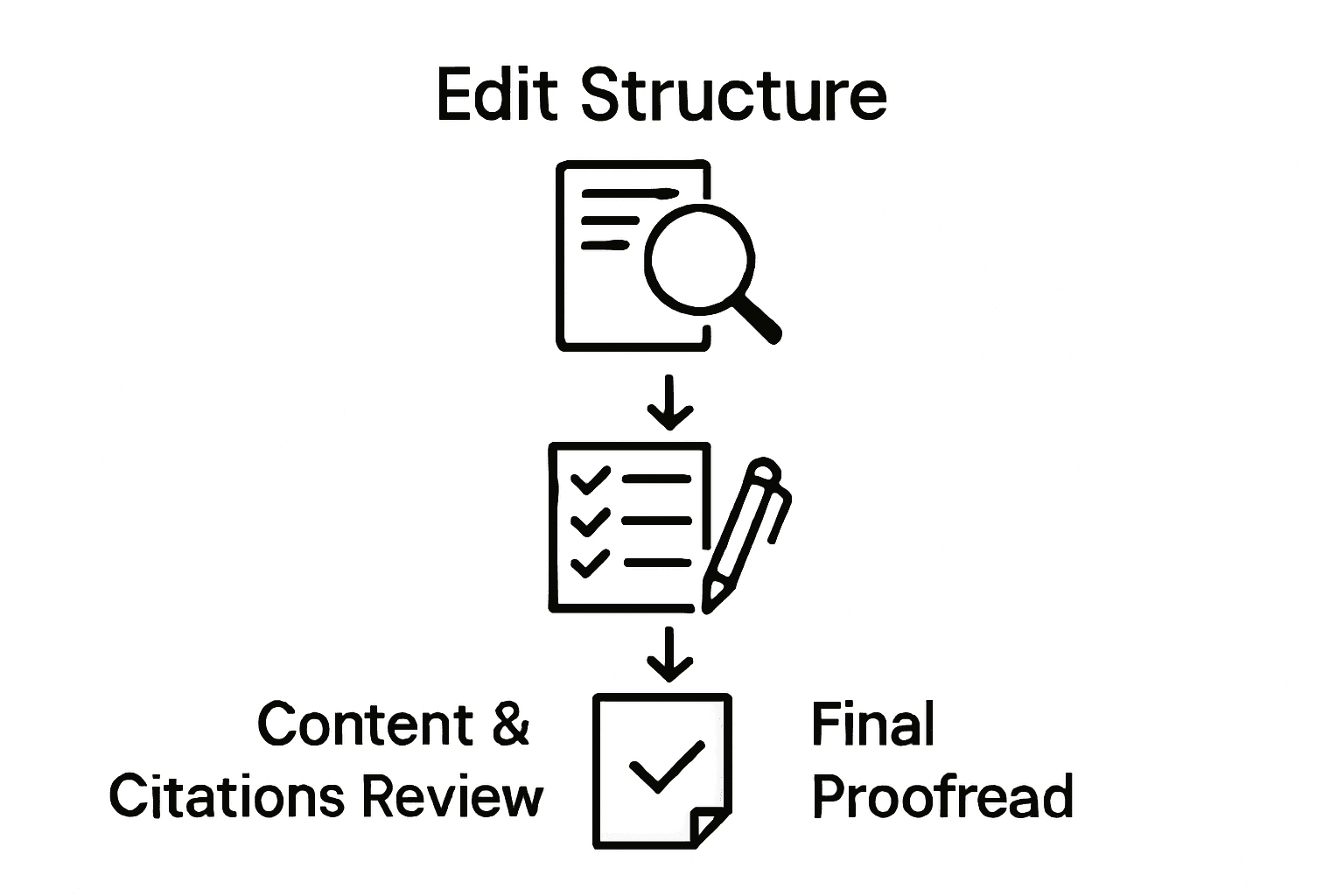
Academic writing guidelines recommend a systematic approach to final document review. Begin with a structural edit by reading your entire paper aloud, which helps you catch awkward phrasing, run on sentences, and logical inconsistencies that might slip past silent reading. Listen for the flow of your arguments and ensure each paragraph transitions smoothly into the next.
Conduct a multilayered proofreading process that addresses different aspects of your paper. Start with content and argument coherence, verifying that your thesis is clearly supported and that each section contributes meaningfully to your overall research question. Then move to grammar and syntax, checking for subject verb agreement, proper verb tense, and eliminating unnecessary words that might cloud your message.
Focus on formatting precision. Verify that your document adheres exactly to your academic discipline style guide requirements. This means checking margins, font type and size, line spacing, header formatting, page numbers, and reference list configuration. Pay special attention to in text citations and reference entries ensuring 100 percent compliance with APA, MLA, Chicago, or your specific required style.
Perform a final digital check using multiple tools. Run spell check and grammar verification software, but do not rely solely on automated systems. These tools miss contextual errors and cannot replace human judgment. Cross reference your citations, confirm all quotes are accurately transcribed, and verify that your reference list matches exactly with in text citations.
Pro tip: Create a personal proofreading checklist with a sequential workflow. Break your final review into specific passes focusing on structure, grammar, formatting, and citations. Color code or physically mark each pass to ensure you do not skip any critical review steps.
Struggling to stay organized and maintain originality while meeting strict academic standards can be overwhelming. This guide highlights the crucial challenges you face such as managing citations accurately, structuring your outline carefully, and ensuring your final draft is clear and plagiarism-free. If you want to transform your research process and writing workflow, integrating intelligent assistance is key.

Unlock the full potential of your academic writing with Samwell.ai. Whether you need help drafting a precise outline with Guided Essays, targeting specific content improvements using the 'Power Editor,' or ensuring rigorous citation compliance and originality checks, our AI-driven platform supports every step described in the Academic Writing Checklist. Join over 1,000,000 students and academics discovering how technology can ease the burden of research organization and final proofreading. Start crafting scholarly papers that reflect your true insight today by visiting Samwell.ai. Your step-by-step guide to excellence deserves the best digital writing partner.
The first step is to organize your research and define your objectives. Clearly identify your core research question or thesis statement, and break it down into specific sub-questions to guide your investigation.
To create a well-structured outline, understand the standard components required for your discipline. Map out your main sections, including the introduction, methodology, findings, and conclusion, ensuring consistency and flow between each part.
Utilize digital reference management software to catalog your sources and citations efficiently. Create a research tracking spreadsheet to organize details like source information, key quotes, and how each source relates to your research questions.
Ensure originality by critically evaluating your sources and integrating them thoughtfully into your narrative. Regularly use plagiarism detection software and verify that your paraphrased content is genuinely reworded and correctly cited.
During proofreading, focus on structural coherence, grammar, and formatting precision. Read your paper aloud to catch awkward phrasing, and ensure that all citations and references comply with the required style guide.