Loading...

Over 80 percent of American college students report feeling overwhelmed by the demands of academic writing. As research projects grow more complex, mastering a structured process becomes essential. Whether you are new to scholarly work or aiming to refine your method, understanding step-by-step strategies can dramatically improve your results and confidence. This guide delivers practical approaches for each phase of academic writing, from shaping your question to finalizing your draft, blending expert advice with proven American academic standards.
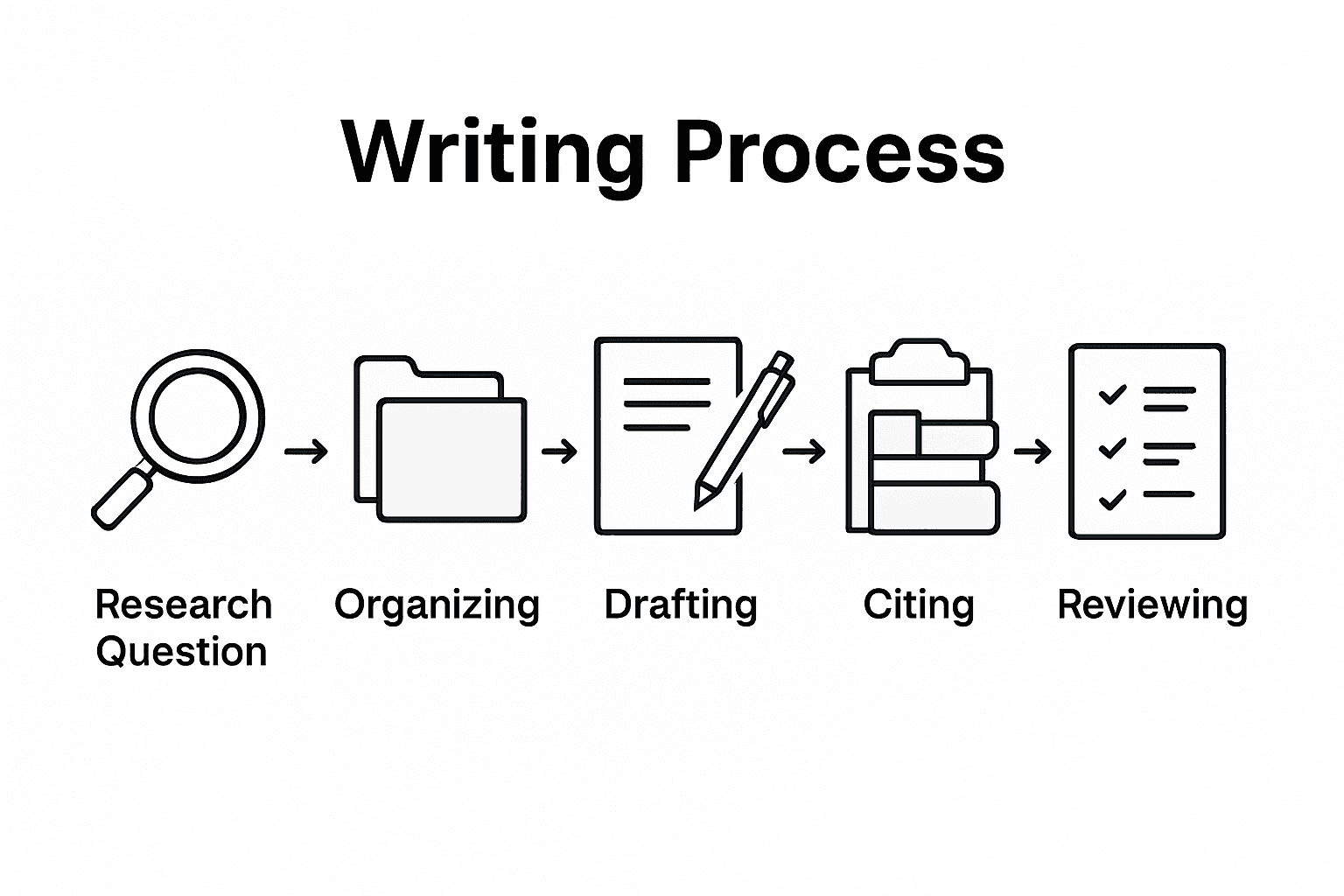
| Key Point | Explanation |
|---|---|
| 1. Define a focused research question | Start by honing your broad topic into a specific inquiry that guides your research direction effectively. |
| 2. Organize ideas through outlining | Create a clear and logical outline to categorize your thoughts, ensuring a coherent narrative flow in your paper. |
| 3. Draft with clear, evidence-based arguments | Construct a well-articulated narrative that connects each argument to your thesis, using credible sources for support. |
| 4. Cite sources accurately and follow formatting | Adhere to proper citation styles to give credit to original ideas while maintaining academic credibility in your work. |
| 5. Review, edit, and ensure originality | Conduct multiple review passes for coherence and clarity, and use plagiarism checks to confirm the integrity of your writing. |
Successfully launching an academic research project starts with crafting a precise research question that serves as your academic compass. Your goal in this step is to transform a broad topic into a focused inquiry that guides your entire investigation.
Beginning researchers often struggle with narrowing their scope, but the process becomes straightforward when you approach it systematically. Start by selecting a topic that genuinely interests you and has sufficient scholarly resources available. New York University recommends exploring background information to help refine your initial concept by investigating existing literature and identifying potential subtopics.
To develop a strong research question, consider these key strategies: ensure your question is clear, specific, and answerable through research. Avoid overly broad questions that would require a book-length response. Instead, focus on a narrow aspect of your topic that can be thoroughly explored within your project's scope. The International Journal of Science and Research suggests creating a question that demonstrates your research's potential significance and innovative approach.
Your research question should act like a laser beam, cutting through potential distractions and illuminating the precise path of your academic exploration. Draft multiple versions, seek feedback from professors or peers, and be willing to refine your question as you delve deeper into your sources.
Pro tip: Create a research question document where you track your question's evolution, noting initial drafts, feedback received, and progressive refinements to help you stay organized and focused.
Transforming your research question into a well structured academic paper requires strategic organization of your thoughts and creating a clear roadmap for your writing. Your primary goal is to develop a logical outline that will guide your research and writing process effectively.

Concordia University recommends using systematic techniques to organize your academic ideas, such as the list-group-label method. Start by brainstorming all potential ideas related to your research question, then categorize them into broader themes or subtopics. Look for natural connections between your ideas and group them in a way that creates a coherent narrative flow. This approach helps prevent random or disconnected arguments and ensures your paper maintains a clear, logical progression.
Building a solid outline is crucial for academic writing success. The University of Nevada recommends limiting your ideas to specific subjects and establishing clear connections between different sections. Begin with a basic structure: introduction, main body paragraphs (each representing a key argument or theme), and conclusion. Within each section, break down your points into specific details, evidence, and analysis. Your outline should be flexible enough to allow for refinement as your research develops, but structured enough to provide a clear direction.
Remember that a good outline is not a rigid constraint but a dynamic tool that evolves with your understanding of the topic. Be prepared to adjust your outline as you conduct research and discover new insights. The most effective academic papers emerge from a process of continuous refinement and critical thinking.
Pro tip: Color code your outline sections to visually distinguish between different types of content such as primary arguments, supporting evidence, and your personal analysis.
Transforming your carefully crafted outline into a compelling academic paper requires strategic thinking and precise articulation of your research findings. Your primary objective is to construct a coherent narrative that clearly communicates your key arguments and insights.
The standard IMRAD structure provides a proven framework for organizing scientific writing, breaking down your research into logical sections of Introduction, Methods, Results, and Discussion. This approach helps you systematically present your research, ensuring that each section serves a specific purpose. In your introduction, clearly state your research question and provide context. The methods section should detail your research approach, while results present your findings objectively. The discussion interprets these results, explaining their significance and connecting them to your broader academic context.
Academic writing guidelines from Dallas Baptist University emphasize the importance of creating a logical argument progression. Begin each paragraph with a clear topic sentence that connects directly to your thesis. Use evidence and scholarly sources to support your claims, ensuring that each argument builds upon the previous one. Maintain a critical yet objective tone, analyzing information rather than simply reporting it. Your goal is to demonstrate your ability to think analytically and synthesize complex information into a coherent academic narrative.
Remember that drafting is an iterative process. Your first draft is not your final product but a starting point for refinement. Write without excessive self editing, then return to polish your work methodically. Pay attention to the flow of your arguments, the clarity of your language, and the strength of your evidence.
Pro tip: Read your draft aloud to identify awkward phrasing, convoluted arguments, and areas that need additional clarity or development.
Properly documenting your research and presenting your academic work with professional formatting is crucial to establishing credibility and demonstrating scholarly integrity. Your goal is to create a polished document that accurately attributes intellectual contributions while adhering to specific academic style guidelines.
Academic writing resources from Mount San Jacinto College emphasize the importance of systematic source documentation. Choose a consistent citation style appropriate to your discipline such as APA, MLA, or Chicago. Each style has unique requirements for in text citations, reference lists, and formatting elements like margins, font, and spacing. Pay close attention to specific guidelines such as header placement, page numbering, and bibliographic entry structures. Carefully track all sources during your research process to ensure you can accurately cite every reference.
Austin Peay State University's writing guidelines highlight the critical role of precise citation practices. When citing sources, always include direct quotes, paraphrased information, and data with appropriate attribution. Use quotation marks for verbatim text and provide page numbers for direct quotes. For paraphrased content, include an in text citation that references the original source. Double check that your citations match the required style guide exactly, paying special attention to punctuation, capitalization, and formatting nuances.
Remember that proper citation is more than a technical requirement. It demonstrates your ability to engage with existing scholarship, build upon previous research, and contribute to academic discourse. Treat each citation as an opportunity to showcase your research depth and scholarly rigor.
Here's a comparison of three major academic citation styles and their key features:
| Citation Style | Common Disciplines | In-Text Citation Format | Bibliography Title |
|---|---|---|---|
| APA | Psychology, Education, Sciences | (Author, Year, p. Page) | References |
| MLA | Humanities, Literature | (Author Page) | Works Cited |
| Chicago | History, Fine Arts, Business | Footnotes or Endnotes | Bibliography |
Pro tip: Create a citation tracking spreadsheet during your research to record source details, page numbers, and potential quote locations before you start writing.
Your academic paper is now a complete draft, and the critical final stage involves refining your work through systematic review, precise editing, and ensuring academic integrity. This step transforms your initial draft into a polished scholarly document that demonstrates professional writing skills.
Advanced research frameworks like the Meow academic outline approach emphasize the importance of systematic review and organizational clarity. Begin your editing process by reading your entire draft multiple times. First, focus on content coherence and argument strength. Verify that each paragraph supports your central thesis and transitions smoothly between ideas. Check that your evidence effectively supports your claims and that your reasoning remains logical and compelling throughout the document.
OCAD University's writing guidelines recommend a structured approach to reviewing academic work. Conduct a comprehensive originality check using reliable plagiarism detection tools to ensure your work is authentic. Compare your citations against original sources, confirm proper attribution, and eliminate any unintentional duplications. Pay special attention to paraphrased content, ensuring you have transformed source material into your own words while maintaining the original meaning.
Remember that editing is an iterative process. Multiple review passes will help you identify and eliminate grammatical errors, awkward phrasing, and inconsistent arguments. Reading your paper aloud can help you catch nuances that visual review might miss.
Pro tip: Set your draft aside for 24 hours before final editing to approach your work with fresh eyes and increased objectivity.
This summary highlights key actions for each step of the academic writing process:
| Step | Main Focus | Critical Action |
|---|---|---|
| Define Research Question | Topic refinement | Craft a clear, focused inquiry |
| Organize and Outline | Structure ideas | Create a logical, flexible plan |
| Draft Paper | Articulate arguments | Present evidence-based points |
| Cite Sources and Format | Attribution and style | Follow precise citation rules |
| Review and Edit | Refine content | Revise and check originality |
Crafting clear research questions, organizing ideas effectively, and maintaining originality are essential challenges in academic writing. This article highlights the need for precise focus and continuous refinement to create compelling papers that stand out. If you find yourself struggling with these critical steps or worried about formatting and maintaining academic integrity, you are not alone.
Samwell.ai offers powerful AI tools designed to help you master these exact challenges. From generating structured outlines with Guided Essays to ensuring meticulous compliance with citation styles like APA and MLA, our platform supports every stage of your writing journey. Benefit from the unique Semihuman.ai technology that minimizes plagiarism risks and provides real-time originality checks so you can write confidently.

Harness the full potential of your research today. Visit Samwell.ai and experience how our advanced features like the Power Editor can transform your drafts into polished, credible academic papers. Don’t wait to improve your writing efficiency and integrity—start mastering academic writing now!
To define a clear research question, start with a broad topic that interests you and narrow it down to a specific inquiry. Focus on crafting a question that is clear, specific, and manageable to explore thoroughly in your paper.
When organizing your outline, include a logical structure that consists of an introduction, main body paragraphs for key arguments, and a conclusion. Break down each section into specific points, ensuring you highlight connections between ideas to maintain a coherent narrative flow.
To draft your academic paper, follow the IMRAD structure, which includes sections for Introduction, Methods, Results, and Discussion. Use clear topic sentences for each paragraph that relate to your thesis, and support your points with relevant evidence and citations.
Properly cite sources by selecting a consistent citation style, such as APA, MLA, or Chicago, and formatting your citations according to the guidelines of that style. Track all your sources meticulously during your research to ensure accurate attribution and adhere to the required citation format for in-text references and bibliographies.
To review and edit your paper, read your draft multiple times, focusing first on the overall coherence of arguments before checking for grammatical errors. Set your draft aside for at least 24 hours before editing to gain a fresh perspective and catch areas needing improvement.