Loading...

Struggling to paint a clear picture with words is a common hurdle for many students in university writing courses. A descriptive essay goes beyond listing facts by using detailed sensory information to create vivid mental images and emotional connections for readers. Learning how to organize sensory details and craft strong impressions can transform your writing, helping your academic voice stand out with clarity and precision.
| Point | Details |
|---|---|
| Descriptive Essay Types | Different types of descriptive essays focus on people, places, objects, experiences, and emotions, each requiring distinct sensory details. |
| Importance of Sensory Details | Including vivid sensory details enhances the reader's experience, allowing them to visualize and emotionally connect with the subject. |
| Organizational Structure | A clear organizational pattern—spatial, chronological, climactic, or thematic—helps maintain coherence and clarity in your writing. |
| Common Writing Mistakes | Avoid vague language, overusing adjectives, and incoherent structure to create more precise and engaging descriptions. |
[content]
Descriptive essays aren't one-size-fits-all. They shift depending on what you're describing and why your reader needs that description.
The most straightforward type focuses on a single subject. You might describe a specific location like your childhood bedroom, a person who shaped you, or an object with deep meaning. These standalone descriptions paint a complete sensory picture within their own essay.
But descriptive writing also appears in other essay formats. When you write a narrative essay, you weave descriptive details throughout to make your story come alive. When you argue a position, descriptive language supports your claims by making abstract ideas concrete and real.
Here are the main types you'll encounter:
The key difference among types isn't the format—it's the subject matter and what sensory details matter most for each topic.
When describing people, focus on distinguishing features and how they move or speak. Place descriptions demand attention to atmosphere and spatial relationships. Objects require texture, size, and color details. Experiences need chronological sensory progression. Emotions need metaphors and physical sensations readers can connect to.
Each variation follows the same core principle: detailed sensory information creates vivid mental images. The type just determines which senses matter most.
Pro tip: Choose your subject type first, then brainstorm which senses will be most powerful for that specific topic—not every essay needs all five.
Here's a quick comparison of descriptive essay subject types and their ideal sensory focus:
| Subject Type | Key Sensory Details | Effective Descriptive Strategy |
|---|---|---|
| Person | Appearance, mannerisms | Use vivid visual and behavioral cues |
| Place | Atmosphere, sounds | Emphasize spatial and emotional context |
| Object | Texture, color, size | Focus on physical and emotional impact |
| Experience | Sequence, feelings | Create chronological sensory progression |
| Emotion | Physical sensation, metaphor | Connect feeling to concrete imagery |
Sensory details separate mediocre descriptive essays from ones that actually stick with readers. Without them, you're just listing facts. With them, you're creating an experience.

The foundation of descriptive writing is vivid language that appeals to all five senses. Most student writers focus heavily on sight—colors, shapes, visual appearance. That's natural, but it's incomplete. Your reader needs to hear, smell, taste, and feel what you're describing too.
Consider a beach. A weak description says "it was a nice beach." A sensory-rich version captures the salt spray on your skin, the rhythmic crash of waves, the gritty sand between your toes, the smell of seaweed and sunscreen, and the taste of salt on your lips. That's immersion.
Here's where sensory details strengthen imagery and emotional connection:
But sensory details alone aren't enough. You also need to describe the emotions associated with your subject. How does this place, person, or object make you feel? Fear? Joy? Nostalgia? Discomfort? Readers connect emotionally when you name those feelings.
Here's the critical part: every detail should serve a purpose. Avoid vague descriptions like "it was interesting" or "it looked nice." Instead, be specific. "Interesting" tells nothing; "the antique mirror's ornate gold frame caught light from three angles" shows something.
Specificity isn't optional—it's what transforms a list of observations into a scene your reader can actually experience.
Organize your sensory details logically. You might move from left to right through a space, zoom from distant to close-up, or progress through time. This structure keeps readers oriented instead of confused.
Pro tip: Collect sensory details by visiting your subject in person or imagining yourself there—close your eyes and ask what would hit each sense first, second, and third.
Descriptive essays in academic settings aren't free-for-all creative writing. Professors expect you to balance personal expression with specific conventions that distinguish college-level work from high school writing.

The foundation is a dominant impression—essentially your thesis. This single, unifying idea shapes every detail you include. Rather than describing everything about a subject, you focus on details that reinforce that one central point. If your dominant impression is "my grandmother's kitchen was a sanctuary during chaos," every sensory detail serves that theme.
Organization matters more than students realize. You can't just dump sensory details randomly and hope readers follow along. Academic descriptive essays use structured patterns:
Your introduction sets the tone and presents your dominant impression clearly. Body paragraphs build upon this through organized, sensory-rich descriptions. Your conclusion reinforces that central impression without simply restating it.
Tone matters too. Creating a dominant impression requires balancing an engaging voice with academic formality. You're not writing for your friends; you're writing for an educated audience with specific expectations about clarity and coherence.
Academic descriptive writing connects emotionally through precise language, not flowery language—there's a real difference between vivid and verbose.
Avoid vagueness at all costs. "The room was nice" fails academically. "The room's pale walls reflected afternoon light in a way that made the space feel simultaneously empty and peaceful" shows mastery. Specificity demonstrates control and sophistication.
Final requirement: maintain objectivity suited to your academic audience. Even when describing emotions, use language that's grounded and credible rather than melodramatic.
Pro tip: Start your draft by writing out your dominant impression in one clear sentence, then use it as a filter—if a detail doesn't support that impression, it doesn't belong in your essay.
Most descriptive essays fail not because of bad ideas, but because writers fall into predictable traps. Knowing what those traps are gives you a major advantage.
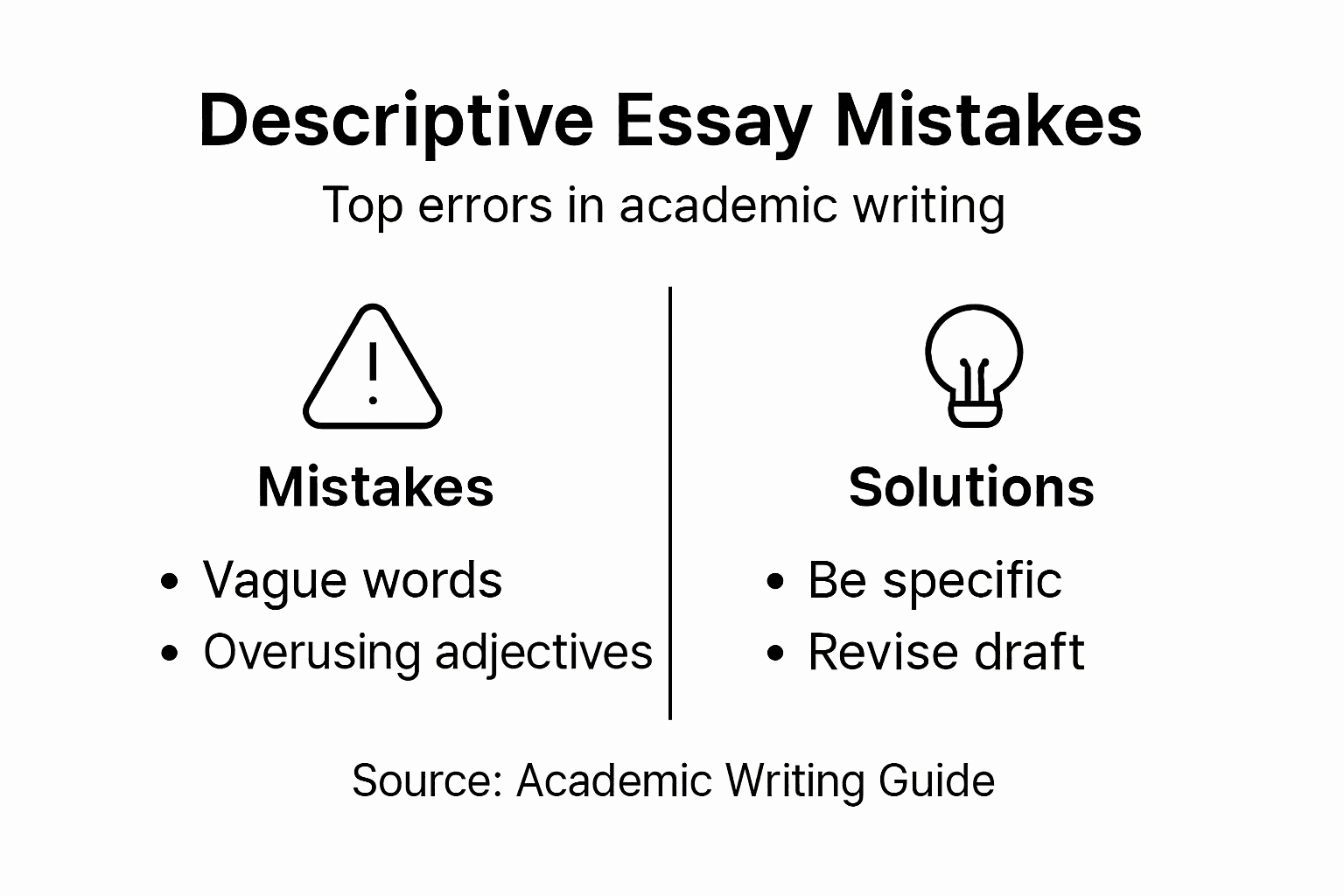
The biggest mistake is vague language. Phrases like "beautiful," "interesting," or "nice" tell readers nothing. They're lazy shortcuts that signal you haven't thought deeply about your subject. Instead of saying something was "amazing," describe what made it amazing—the specific sensations, the precise details.
Overusing adjectives and adverbs creates another common problem. Student writers sometimes think more descriptive words equal better writing. Actually, weak adjectives layered together become noise. "The lovely, beautiful, wonderful sunset was incredibly stunning and amazingly gorgeous" repels readers. One or two precise adjectives work far better: "The sunset burned orange along the horizon."
Incoherent rambling destroys clarity. When you jump randomly between senses without organization, readers lose focus. You describe a smell, then jump to something from five years ago, then back to how something looked. Structure matters—move systematically through your subject, whether spatially, chronologically, or thematically.
Here's what derails most student essays:
Every detail should directly support your dominant impression—if it doesn't, delete it without hesitation.
Another common error involves straying from your subject. Stay focused on one clear subject rather than trying to describe multiple things at once. Your reader needs coherence, not a scattered collection of observations.
Plagiarism concerns also apply to descriptive writing. When using research or sources about your subject, always cite properly and maintain your own voice through description.
Revision solves most of these problems. Read your draft aloud—you'll catch vague language and awkward organization immediately. Ask yourself: Does every sentence serve my dominant impression? Is my organization clear? Did I use the most precise words possible?
Pro tip: After drafting, cut 20 percent of your adjectives and adverbs, then replace the weakest ones with stronger, more specific verbs and nouns.
The following table summarizes common descriptive essay mistakes and practical solutions:
| Mistake Type | Impact on Writing | Recommended Solution |
|---|---|---|
| Vague Language | Weak, unconvincing images | Replace with precise descriptions |
| Adjective Overuse | Distracts and confuses | Use focused, strong nouns and verbs |
| Poor Structure | Confuses readers | Organize details logically |
| Subject Drift | Reduces coherence | Maintain clear essay focus |
| Plagiarism | Damages credibility | Incorporate proper citations |
Writing a descriptive essay that truly engages readers and meets academic standards can be challenging. This article highlights the importance of vivid sensory details, organized structure, and maintaining a dominant impression to create compelling descriptions without falling into common pitfalls like vague language or poor organization. If you struggle to balance creativity with academic precision or want to ensure your essay captures powerful imagery clearly and cohesively, there is a solution designed just for you.

Discover how Samwell.ai can transform your descriptive essay writing by providing advanced AI-driven tools tailored for academic success. Utilize features like the 'Power Editor' to enhance and focus your sensory details, 'Guided Essays' to maintain clear organization around your dominant impression, and real-time AI detection to maintain originality with confidence. Join over 1,000,000 students who have elevated their writing by blending creativity with academic integrity. Start today at Samwell.ai and master descriptive essays with ease.
The key elements of a descriptive essay include vivid language that appeals to all five senses, a dominant impression that serves as the central theme, and organized sensory details that create a coherent picture for the reader.
To enhance the vividness of your descriptive essays, focus on using specific sensory details—describe sights, sounds, smells, tastes, and textures. Avoid vague adjectives and instead, choose precise nouns and strong verbs.
The dominant impression is crucial because it unifies the essay. It shapes the selection of details and guides readers' understanding of the main point you want to convey about the subject.
Sensory details can be organized spatially, chronologically, climactically, or thematically. Choose an organization method that enhances clarity and helps the reader visualize the subject, maintaining a logical flow throughout the essay.